
Thursday, 31 March 2011
Group: 31/03/11 Progress
Today, we received some feedback on our rough cut of our opening sequence. We have decided to change the colour of our two lines of action during and after the murder, and also the scene in the Psychopaths bedroom will be re-shot as the colour is quite grainy and is a lower quality to the other scenes outside, which is noticeable when viewing them together.

Wednesday, 30 March 2011
Group: Wednesday 30/03/11 Group Progress:
We have now got all the footage we need, and majority of the sound. Our focus now is to sort out the music and also some fine tuning with the colour. All in all we have every shot we need and the framing is perfect. Also we have managed to convey the Thriller/horror genre due to the colour and also the silent murder with no blood. It is going well.
Group - Tuesday 29/03/11 work
We have decided that we are going to use the footage we shot on our first shoot, which at first we thought had some problems but we now believe we can overcome these problems by adding effects and carefully editing the parts of the scene we dislike. We have also made progress on our editing of our second shoot by adding all of the sounds we wished to use and are know finalising our titles.
Tuesday, 29 March 2011
Group: Ideas Movieclips.com
I have looked at a clip of a garrote killing, and I believe blood makes the garroting look much more believable.


Monday, 28 March 2011
Group: Editing
We have shot and edited the first 35 seconds of our opening, however after rendering we have realised that the fonts need to be changed to the Credits having just an "arial" font, and just have the "Ball Tongue" font for the Title "HITLIST" Also we have decided we need to take the redness out of the clip, as the wallpaper is orange and the camera picks up a slight pink/redness on each clip, as it gave the connotations of a female character and romance within our production. Thus we are changing the colour by taking out the red and adding blue; this needs to be done very subtly though in order not to reduce the quality.
Group: Wednesday/Thursday/Friday Lesson
During the Wednesday and Thursday lessons, as a group we were focusing on finding the sounds to suit our clip. We used the website www.freesound.org and typed in key words to help us narrow down our search. The sound files we found and wish to use in our clip are:
- http://www.freesound.org/samplesViewSingle.php?id=33637 This sound will be used when the items on the Psychopath's bed disappear.
- http://www.freesound.org/samplesViewSingle.php?id=716 This sound will be used at the end of our scene in the Psychopath's room, as it builds tension as the the scene fades to black.
On the Friday lesson with the sounds we had found we put onto our opening and it worked really well.
GROUP Storyboard Completion
Storyboard: 8th march completed for our first shoot on 12th march saturday, then second shoot filming the killers room on 18th march friday. 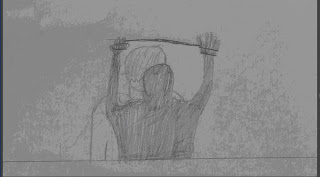
Sunday, 27 March 2011
Feeback
Guys - I'm concerned that there has been no more progess on the blog. Despite being set this work, little seems to have been done this week and no posts since Thursday? What did you do all week? What did you do in the lesson on Thursday? Using this blog as a record of all processes is NOT an option for a L4- if they are not there, then I will assume you have done nothing.
Thursday, 24 March 2011
Group: Final of the beginning of the opening:
Cameron filmed this part on his own within his bedroom, he found it both a success and a struggle.
We didn't believe he would need a tripod, and thus trying to keep the camera steady posed a problem, however he got round this by making the whole section as a POV with a few bird's eye views too.
Also another difficult factor was the lighting, which had to create a shadow of the killer walking around the room and looking at some pictures, but not to show the shadow of the camera being held. Cameron got round this problem by using a desk lamp, as the only source of light which created brilliant shadow effect, and also an sinster dark look to the bedroom, which is representational to the killer.
All in all the shot went well, however we have learnt from this reccie that we need to have at least two people at every shoot.
We didn't believe he would need a tripod, and thus trying to keep the camera steady posed a problem, however he got round this by making the whole section as a POV with a few bird's eye views too.
Also another difficult factor was the lighting, which had to create a shadow of the killer walking around the room and looking at some pictures, but not to show the shadow of the camera being held. Cameron got round this problem by using a desk lamp, as the only source of light which created brilliant shadow effect, and also an sinster dark look to the bedroom, which is representational to the killer.
All in all the shot went well, however we have learnt from this reccie that we need to have at least two people at every shoot.
Sunday, 20 March 2011
Tuesday, 15 March 2011
First Shoot
- Our first shoot was overall, unsuccessful as there were some key issues we discovered while shooting and editing.
- We shot outside during the day, and it was too light for our production of a thriller/horror opening sequence.
- After editing, we have found that we use our time effectively, as we had over four minutes of edited footage which is too long for our production.
- However, our first shoot has highlighted the factors and issues we must consider when planning and shooting.
Monday, 7 March 2011
Group: Preliminary Task findings
From our Preliminary Task we have realized the hardships of continuity editing and also how many shots are needed in order to seem to follow a continuous line of action whilst keeping the audience interested in our film.
One major thing we have found is trying to use sound effectively, we have realized that it transforms a piece of footage, however we need to work on and execute the art of fading in and out of bits of music as to not add distortion effects where not necessary or wanted.
Another major thing we have learned from this piece of filming is the difficulty of portraying violence in this case a punch and a kick. We filmed the punch with myself (Cameron Moffatt) acting the punch out extremely slowly and tried in editing to quicken the pace of the punch however this didn't work in the way we had hoped it would. Also the kick didn't seem to convey or have enough power to seem real, thus we have deduced we need to attempt to work on the realism of our productions.
It is important for us to focus on realism as we are hoping for our production to be highly realistic and plausible in order to capture the audiences attention and keep them on edge throughout our opening which is a key part of a Thriller/Horror genre.
One major thing we have found is trying to use sound effectively, we have realized that it transforms a piece of footage, however we need to work on and execute the art of fading in and out of bits of music as to not add distortion effects where not necessary or wanted.
Another major thing we have learned from this piece of filming is the difficulty of portraying violence in this case a punch and a kick. We filmed the punch with myself (Cameron Moffatt) acting the punch out extremely slowly and tried in editing to quicken the pace of the punch however this didn't work in the way we had hoped it would. Also the kick didn't seem to convey or have enough power to seem real, thus we have deduced we need to attempt to work on the realism of our productions.
It is important for us to focus on realism as we are hoping for our production to be highly realistic and plausible in order to capture the audiences attention and keep them on edge throughout our opening which is a key part of a Thriller/Horror genre.
Location Reccie
Through our location reccie we have realized that lighting has a huge impact on the atmosphere of the production, due to our genre being a Thriller/Horror we will need the lighting to be dark and dull, nothing highly exciting.


Also the angle of shot is very important in order to insert a sense of distortion within our production.
Finally due to the fact within one of our locations there is a unmovable mirror we will have to be careful in order not to have shadows present or the film crew itself. This Location Reccie has made us aware of effects needed and also camera positioning both angle and actually were it is in the room.


Also the angle of shot is very important in order to insert a sense of distortion within our production.
Finally due to the fact within one of our locations there is a unmovable mirror we will have to be careful in order not to have shadows present or the film crew itself. This Location Reccie has made us aware of effects needed and also camera positioning both angle and actually were it is in the room.
Tuesday, 1 March 2011
Tuesday, 15 February 2011
Monday, 14 February 2011
Group Wilderness Woods Recce Evalution
- The wilderness recce gave us all an insight into about how to approach the filming of our opening.
- First key area we must manage is our time management of when doing certain shots, some of the time we over thinked the shots and spent too long on them others we didn't and prove to be quiet rushed for example cutting to early.
- When preparing whats need to be done and how it will be laid out, we should make sure that we keep with continuity in order to create sense of continuous action, however not to go overboard and do to many shots to show every movement and not to go to the other extreme and to go to fast through the story and get no sense of what is happening.
- The other problem we found with continuity is that making sure when filming keep the right positions and same way in which dressed as in our practice recce showed that Cameron had forgot to keep his hood up thus breaking the continuity however over flaus such as direction and placing of when I was running.
- Overall the recce was a valuable task and also upon the editting of the clip helped us to gain knowledge and understanding of how to use the equipment and how to use it effectively.
Sunday, 13 February 2011
CF feedback - product research/ideas dvpt
Well done - you are working very effectively as a group and your research is well chosen and in some parts thorough and reflective. The film opening analyses were excellent. However, in order to secure a L4, you will need to make the following changes:
1. All 3 technical analysis are not detailed enough - look at some of the other groups' work
2. Cameron - you must use ICT more effectively in your posts - use images, highlight key terms. When presenting the treatment and shot ideas you need to think about layout of posts
3. Ensure that all your ideas on location, costume, narrative are clearly documented
Sam - prezi doesn't load?
1. All 3 technical analysis are not detailed enough - look at some of the other groups' work
2. Cameron - you must use ICT more effectively in your posts - use images, highlight key terms. When presenting the treatment and shot ideas you need to think about layout of posts
3. Ensure that all your ideas on location, costume, narrative are clearly documented
Sam - prezi doesn't load?
Friday, 11 February 2011
SH: Institutional Context
Production
If our opening sequence were to be developed and made into a film, it would most likely be produced by a conglomerate and therefore be an industrial film. This is because the film is a thriller, which are produced mainly by large studios and independent film companies may struggle to gather enough finance for a film belonging to the thriller genre, as actions scenes are used and many conventional props and locations, such as police stations and weapons, may be expensive.
Distribution
The film would be distributed through a company owned or co-owned by the production company as they may be run by a conglomerate. It would most likely be on wide release to achieve maximum sales across the market, and would be marketed using posters, trailers on the TV and the Internet, and other viral marketing methods such as advertising on Facebook.
Exhibition
The film may be exhibited by companies owned or co-owned by a conglomerate, for example the Odean cinema chain is owned by Vivendi Universal, which may be beneficial to the film as it can take priorities in the cinema by having prime time slots and being advertised. The film would not be a tentpole however, as it would not appeal to the four quadrants, but would still be a mainstream film which will still appeal to a large audience; 15-24 age group as it contains some action and violence, and also 25-34, 35-44, 45-54 age groups as well as it is enigmatic and audiences will be intrigued to find out what happens.
If our opening sequence were to be developed and made into a film, it would most likely be produced by a conglomerate and therefore be an industrial film. This is because the film is a thriller, which are produced mainly by large studios and independent film companies may struggle to gather enough finance for a film belonging to the thriller genre, as actions scenes are used and many conventional props and locations, such as police stations and weapons, may be expensive.
Distribution
The film would be distributed through a company owned or co-owned by the production company as they may be run by a conglomerate. It would most likely be on wide release to achieve maximum sales across the market, and would be marketed using posters, trailers on the TV and the Internet, and other viral marketing methods such as advertising on Facebook.
Exhibition
The film may be exhibited by companies owned or co-owned by a conglomerate, for example the Odean cinema chain is owned by Vivendi Universal, which may be beneficial to the film as it can take priorities in the cinema by having prime time slots and being advertised. The film would not be a tentpole however, as it would not appeal to the four quadrants, but would still be a mainstream film which will still appeal to a large audience; 15-24 age group as it contains some action and violence, and also 25-34, 35-44, 45-54 age groups as well as it is enigmatic and audiences will be intrigued to find out what happens.
Thursday, 10 February 2011
Technical Issues with cameras
When we capture footage with the cameras and edit the footage, the camera and editing software must have the same settings, so that the footage can be edited correctly. The settings on the camera are 1140 x 1080, which makes them 1080i HD cameras. The frame rate is also 25 frames per seconds, so the editing software must be set to these same settings.
Monday, 7 February 2011
Technical Analysis: Memento: Christopher Nolan, 2000:
Memento: Christopher Nolan, 2000:
- I have learnt that even in openings when not much happens there are many cuts which show the audience each piece of mise-en-scene and gives ideas into the audiences thoughts of what has happened, why it has happened and when it happened.
- Also the different angles of shots gives the audience different reactions towards certain characters, by having a birds-eye view of the dead man there is no emotional connection with the body and feel no sympathy for this person. But by having a low angle looking up at the man in the suit makes the audience respect him and view his power and control over the situation.
- The quickening of the cutting rate also makes the audience feel tension and anxiety as something is about to happen or be revealed which is enigmatic for the audience and keeps them interested in your opening and thus your entire film too.
Technical Analysis: Suspect Zero
- For the technical analysis, I analysed 'Suspect Zero' in which there were around 17 shots. I believe this is quite short for an opening sequence, and this may be due to the title sequence showing the titles for quite a long period of time.
- I think we should not spend too long showing the title, actors and crew members of the film as this will limit the time we will have to show our enigmatic opening.
- We could also incorporate the titles into the action, rather than having the title sequence and the action completely seperate.
Sunday, 6 February 2011
AT Technical Analysis
Law Abiding Citizen(Gary Gray,2009)
Shot 1: Shows a girl making a braclet, use of a CU to show the name on the braclet and what she is doing, with a POV shot to reveal the braclet and get an insight into the characters view point and use of iconography of the braclet which not expected in the genre of a thriller, use of props being the beads and braclets connotes child environment.
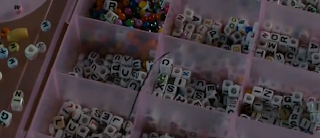
Shot 2: Shows her father talking to her about what she is doing. We do not see him however a CU of the machine he is working at is shown and the use of a sound bridge to make out he is talking to her and they are in conversation. Machinery often linked with males as being rugged job however he is doing a precise job but still stereotype of males fixing things or working.
Shot 3: Cuts to the father talking MCU. Doesnt apear to be doing strenuious work and wearing relaxed casual clothing.
Shot 4: Conversation between the father and daughter her talking about what she is making a POV shot used to see his eyeline looking down on her. Props use of table show her sitting up at the table working.
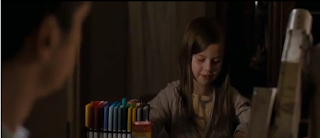
Shot 6 -13: Conversation continuing with introduction of the mother in shot 7 with use of sound bridge almost as if she is calling out to the father to get him to answer the door.
Shot 14: Father walks over to the door to answer it, use of stedi-cam following him effect. Nice middle class house due to quiet fancy and neat good lighting throughout house.
Shot 15-19: Father is hit with a baseball bat and is beaten up by one man while the other enters and turns of the lights and then seals the mans hands with varying shot sizes from mid shots to CU of the mans hands and facial expresions. Both attackers wearing rugged clothing and have a rough apearence especialy main antagonist.
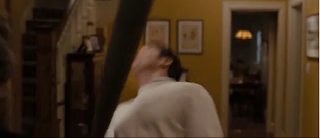 Shot 20 -21: Shows the mother entering the hallway of where he is being beaten, shot goes from a mid shot to a MCU to get her reactions more. The use of the reaction shot as we hear the scream before we see her.
Shot 22: Shows the mans legs running over to the women with use of stedi-cam to make it feel like a head turn. However it is a quick swish pan to help create the speed of it.
Shot 23: Reaction shot shows what the women was looking at her husband on the floor tied up and trying to free himself.
Shot 24-28: Cutting rate picks up as women is thrown into a cabinet followed by the masking up of the mans lips to keep him quiet all in MCU of the man to show him strugle and show his positioned where as the women is shot in a mid shot.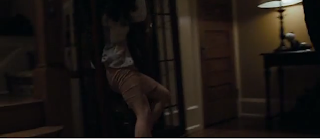
Shot 29: We get a CU of the attackers face and of the knife in his hand showing the iconography and symbolism that the knife represents especisaly in this genre. Antagonist talks however doesn't seem to lead to anything and we don't seem to get any clues as to why leaving mystery.
Shot 30: He is stabbed with use of the sound to dramatise the knife going into his body. Also frammed in the shot is his face to show his reaction to the build of before getting stabbed then as he is stabbed.
Shot 31: Then the blood is wiped on his jumper all in a MCU. Seen as more of a robery but also an assult.
Shot 32: The two men pack up to leave and it fades to black connoting his eyes clossing also the slow fade connotes how quickly it has happend and the slow fade gives time to reflect on the opening seqeunce.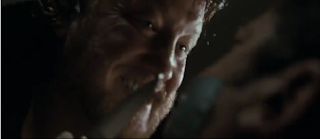
Review:
Shot 1: Shows a girl making a braclet, use of a CU to show the name on the braclet and what she is doing, with a POV shot to reveal the braclet and get an insight into the characters view point and use of iconography of the braclet which not expected in the genre of a thriller, use of props being the beads and braclets connotes child environment.
Shot 2: Shows her father talking to her about what she is doing. We do not see him however a CU of the machine he is working at is shown and the use of a sound bridge to make out he is talking to her and they are in conversation. Machinery often linked with males as being rugged job however he is doing a precise job but still stereotype of males fixing things or working.
Shot 3: Cuts to the father talking MCU. Doesnt apear to be doing strenuious work and wearing relaxed casual clothing.
Shot 4: Conversation between the father and daughter her talking about what she is making a POV shot used to see his eyeline looking down on her. Props use of table show her sitting up at the table working.
Shot 6 -13: Conversation continuing with introduction of the mother in shot 7 with use of sound bridge almost as if she is calling out to the father to get him to answer the door.
Shot 14: Father walks over to the door to answer it, use of stedi-cam following him effect. Nice middle class house due to quiet fancy and neat good lighting throughout house.
Shot 15-19: Father is hit with a baseball bat and is beaten up by one man while the other enters and turns of the lights and then seals the mans hands with varying shot sizes from mid shots to CU of the mans hands and facial expresions. Both attackers wearing rugged clothing and have a rough apearence especialy main antagonist.
Shot 20 -21: Shows the mother entering the hallway of where he is being beaten, shot goes from a mid shot to a MCU to get her reactions more. The use of the reaction shot as we hear the scream before we see her.Shot 22: Shows the mans legs running over to the women with use of stedi-cam to make it feel like a head turn. However it is a quick swish pan to help create the speed of it.
Shot 23: Reaction shot shows what the women was looking at her husband on the floor tied up and trying to free himself.
Shot 24-28: Cutting rate picks up as women is thrown into a cabinet followed by the masking up of the mans lips to keep him quiet all in MCU of the man to show him strugle and show his positioned where as the women is shot in a mid shot.
Shot 29: We get a CU of the attackers face and of the knife in his hand showing the iconography and symbolism that the knife represents especisaly in this genre. Antagonist talks however doesn't seem to lead to anything and we don't seem to get any clues as to why leaving mystery.
Shot 30: He is stabbed with use of the sound to dramatise the knife going into his body. Also frammed in the shot is his face to show his reaction to the build of before getting stabbed then as he is stabbed.
Shot 31: Then the blood is wiped on his jumper all in a MCU. Seen as more of a robery but also an assult.
Shot 32: The two men pack up to leave and it fades to black connoting his eyes clossing also the slow fade connotes how quickly it has happend and the slow fade gives time to reflect on the opening seqeunce.
Review:
- Overall from the technical analysis I undertook, helped me to get an understanding of the variety of shots used and how these can be interlinked
- How character exposition is key in this opening, and is something we should think about when doing our opening.
AT Analysing an opening sequence: Genre, Film Language, Narrative
Watchmen(Zach Synder, 2009)
Genre
- The genre of the film watchmen is a thriller and the sub genres of the film are: action, sci-fi, mystery.
- The generic expectations of this film are fulfilled as it has the thriller element of why is this happening? Then with the action of the fight scene, expansion of time to create dramatic effect. Sci-fi with the in-human fighting abilities and strength to throw a fully grown man across the room with ease, however later on in the film we get the full sci-fi generic expectations with a spaceship and as we are introduced to the other characters. And finally we get the mystery of who is this man who has just come in and killed this man? Why is he killing him? What has the other man done? Why does he want this man dead? Many of questions linked with the mystery sub genre.
- The text does conform the characteristics of the genre and sub genre's however later on in the film the characteristics of the genre and sub genre's are more playful and ironic, especially within the sci-fi sub genre it is portrayed in the classic sci-fi way in order to connect the audience more however comes of as being ironic and playful with the sci-fi characteristics.

Film Language
- The whole opening sequence is set in the "Comedian's" apartment and seems to have a dull and blue colourwash the meaning conveyed by this colourwash is to help create a sense of the time of day in this case representing night time when it could of been shot durring the day. The room is not lit very well and therefore helps to convey the sub genre of mystery also reinforced when we see the shadow upon the floor. The setting helps to convey the main genre of a thriller as it is a idealistic place to hold a fight where some one breaks in adding the mystery of why the man breaks in and what his motives are for killing him.
- There was a variety of camera techniques to help convey different meanings within the text. The first being the use of a MCU of one of the main characters right at the start at the movie establishes who we are positioned with identifying which side we are with and in this case we follow the protagonist. Then the use of a slow track in on the TV screen of which he is watching shows that he is focused in on the TV showing his interests. Use of a high angle on the man in his dressing gown which is followed by a CU to show his facial expression's, however he appears to not be fazed by the other mans appearance also reinforcing the protagonist stereotype of fears nothing.
- The music in the background is in such a contrast with the opening scene as it is relaxed and slow whereas the fight is quite quick and is over within a minute. This helps to notice what has happened him sitting alone watching TV then someone breaks in and kills him represents the irony of it all. Selective sound used on the punches and smashing to reinforce the sub genre of action also to help us identify what our main focus is with it competing with the music of the song.
- We don't learn much about the characters through the dialogue as there is only little amount of it. Also the non verbal language of the characters doesn't tell us much about them as both stand in dominating positions and from their facial expression show that this is just a normal fight to them.
- The director uses allot of expansion of time this does help to dramatise the text by slowing down key punches or key elements to make them more visually attractive. Another visual technique used is the props, most being expensive breakable items which make it seem more intense fight.

Narrative
- The narrative is organised in an asynchronous way starting at the middle and then during the film flashes back then continues from the very beginning to the very end.
- The audience are positioned with the protagonist therefore we get the view of the archetypal hero.
- The major theme in the narrative is that some man has killed this other man for some reason and this will lead to this investigation being carried out in the film giving us an opening.
- Tension is created and built by the use of the minor key music playing leading us to a false sense of security then as we see the use of a stedi-cam walking towards his apartment slowly builds tension, then the cut to his face to glare down at the shadow upon the floor by the door then the slow motion break in and other uses of expansion of time to make the action last longer and make it more significant and this within juxta position with the normal tempo of the clip maintains the tension.
Wednesday, 2 February 2011
Tuesday, 1 February 2011
CM Analysing an opening sequence: Representation and Ideology, Media Audience, Institutional Context
Fight Club: David Fincher: 1999
Representation and Ideology:
Institutional Context:

Representation and Ideology:
- The social groups represented in the opening sequence are both middle and working class, the two classes are represented via their clothing, with the middle class man wearing a shirt and jacket and the working class man (Brad Pitt) wearing a coloured tank top and denim jeans holding a gun. This represents the lack of funding to be able to afford nicer more presentable clothing, as apposed to the middle class man.
- The values and beliefs upheld in this opening are the stereotypical view of males with cuts down their faces, most likely due to violence which is a male trait and also the weapon of a gun being held in the man's mouth which suggests again violence. This is regressive towards the male gender as is stereotyping them as violent and not reasonable.
- The characteristics of a thriller are that the opening is enigmatic in order to capture the audiences attention. In the fight club opening which is a film aimed at a male audience it begins with starting at a cell in the body and the camera back tracking through and out of the body and then seeing a gun within a persons mouth. Instantly there are questions of why is this happening, who are these people, and why are they injured (cuts down their faces) this attracts the male audience due to the fact is macho.
- The target audience of "Fightclub" are men between the ages of 18-26, this is a large audience that enjoy watching thriller films that are based around male interests. Thus "Fightclub" will be able to connect easily with that target audience and the pitch when it was trying to get green lighted had a target audience identified that they knew got seats in the cinema.
- The probable audience reading of the text is that a man is being held hostage with a gun held in his mouth and is in a deadly situation. However the possible reading is that these two characters are friends and have had a slight falling out due to the fact that the gun gets taken out of his mouth and that you hear narrate "I can't think of anything" in a mocking tone of voice suggesting that they have a connection that will be discovered during the film and that it is also the end of the film as the audience would want to know how they know each other.
- As a British Teenager, who is sixteen, male and from a middle class background read this media text in its possible reading. As I have evaluated the situation and enjoy trying to work out what could be happening underneath the surface of the film, thus I don't accept the probable reading. Due to my age I can be naive to watching eighteen certificate films and may not understand if I am supposed to take a probable or the possible reading. Also as I am male, I enjoy watching films to be entertained and occasionally enjoy just taking the probable reading as want to just consume what I am being presented with, without giving any thought to what could be happening or about to happen.
Institutional Context:

- A star has been used in this film Brad Pitt one of the lead roles of Tyler Durden. This is important as he is a big actor and will have a huge fan base which will attract people outside of the target audience to come and view this film due to wanting to follow Brad Pitts work.
- 20th Century Fox produced this film in 1999, this makes the film industrial as a big conglomerate has funded the production being able to get bankable stars and a good director to create the film.
- The film had trouble marketing as the studio didn't know how to attract the audience they where hoping for as they weren't too sure whether the film was an industrial film or an art house film. In the end the studio gave an investment of $20 million to fund a large-scale campaign to provide a press junket, posters, billboards, and trailers for TV that highlighted the film's fight scenes. The studio advertised "Fightclub" on cable during World Wrestling Federation broadcasts, which Fincher protested, believing that the placement created the wrong context for the film.
- The opening does have very evident institutional context mainly by having the two stars of Brad Pitt and Edward Norton immediately shown which are expensive actors that independent film producers wouldn't have been able to afford.
CM: Opening Sequence:
Starts with Close up shots of a pair of black gloves, then cutting to a black hoody, cutting to a black balaclava and finally cutting to a knife. Then has a bird's-eye view of all the items on a desk and with jump cuts each item disappears consecutively and underneath where that item was appears our names as credits. Then the man wearing the black gloves picks up a photo and the camera looks into it and retracts out of it to a journalist working late at night in a dark office with the only light source a desk lamp and computer monitor. Then the screen goes black as is a extreme close up on the man with the black hoody's back and as he walks away from the camera light appears gradually around the outside growing inwards, then he walks up silently behind the journalist and stabs him to death. Then wipes the blade clean of blood and lobs the tissue in the bin and walks away. A pool of blood drips down and creates the title of the film. Then there is a fast rewind through the whole event and screen goes black with some more credits in white colour and a loud reverberating drum beat, which is simultaneous to a pair of eyes opening fast, this ending the opening sequence with just the white of the eyes visible from a bird's-eye view.
CM: Treatment for our Production:
A Thriller-Horror involving a revenge driven psychopath trying to make the world pay for the death of his brother, by killing lawyers, judges and journalists. Due to the fact that his brothers murderer wasn't sentenced and that the journalist reporting the court case was supporting the decision, and so takes his revenge by killing their loved ones to make the people he is trying to hurt feel the pain he felt. The Pyschopath murders leaving clues for the detective each time. Eventually the Detective closes down on the killer at the last murder but is unfortunately too late to save the victim and arrests the killer. At the police station explains that the psychopath killed his own brother during his childhood, and admits the killer to an insane asylum. This means that his brothers killer is never sentenced. Also whilst at the police station the killer confesses that he wanted to be caught but was not sure why exactly why, but he always had a feeling of guilt about killing the people he did. Once the police officer explains the situation to the killer, the Psychopath realises it is the truth and understands his guilt, and willing goes to the insane asylum for life.
Monday, 31 January 2011
CM Analysing an opening sequence: Genre, Film Language and Narrative:
Se7en: David Fincher, 1995:
Genre:
Genre:
- Se7en belongs to a Thriller as its main genre with a sub-genre of psychological horror.
- The audience are completely getting what they expect from a psychological thriller, which is immediately showing a weapon (knife) and also a dead body and blood with a detective trying to work out how this has happened and why and who. Also with the title sequence being shown in montage editing it also demonstrates the distortion of the psychopaths mind who is cutting off his fingerprints and also scribbling in a note book in a crazed fashion.
- The text does conform to the characteristics of the genre, with the detective who is male which is a generic convention of a thriller, also the dead body character which is also highly generic to the genre.
- Mise-en-scene conveys the meaning of this sequence with the weapon of a knife which is immediately setting up the fact that violence is a regular occurrence and will most likely take place in the film. Furthermore the pool of blood, which connotes death, and also murder which is a strong convention of thriller genres. Also with the scribbled in notebook shows unstable and potentially insane man, which again is the normal characters seen in thrillers.
- The camera shot size, movement and angle also conveys meaning with the pedding up to reveal a dead body which connotes mystery of how and why this has happened, slowly revealing to the audience the situation that they have been placed in. Also the low angle shot on Detective Somerset shows a high up role in the film and that he is who the audience will respect during the film, and with a shot size of medium shot on Detective Somerset allows the audience to immediately register him as a character who will be prominent in the film.
- With the title sequence sound anchors the images via having a montage edited piece of film with a sound bridge that is very disjointed and scratchy on the ears. This creates a sense of insanity of the person who the audience are then positioned with during the title sequence.
- Through the dialogue and non-verbal language of the characters you can learn much. For example, Detective Somerset is very calm, collective and thinking as logically as he can focusing on the job saying "Did the kid see it?" (talking about the murder) which isn't caring for feelings of people just getting his job done. Yet Detective Mills runs up the stairs when we first meet him connoting youth as is fit and excited about the situation he is in, this leads towards the notion that he could be very naive and irrational with his way of life.
- Other visual techniques that the director uses are stock locations which are dark, small crampt rooms and also the usual weather of thrillers which is either raining or overcast to again reassert the darkness of the situation the characters are in.
- The form of the narrative is beginning with the character exposition, starting with the main character being established as the audience is positioned with him (Morgan Freeman) Detective Somerset, then going onto the introduction of (Brad Pitt) Detective Mills "I've just arrived in town twenty minutes ago," immediately showing the audience that Detective Mills is new to the area and the job too. Finally the introduction of the psychopaths hands which has set up the three main characters within two minutes.
- The audience is positioned in a linear position to the narrative, by starting where the film begins with the first meeting of the two main detectives.
- The techniques of identification are that the two detective's names are immediately stated to the audience giving them an identity. Furthermore through the police officer saying to Detective Somerset "we'll all be glad when we get rid of you" showing that he is alone until meets his successor Detective Mills. Also at the very beginning Detective Somerset is shown alone in his home which connotes loneliness and alienation at home and at work.
- The major themes in this narrative is death and murder, this is shown through the use of mise-en-scene and dialogue. Mise-en-scene has the dead body and blood, and the dialogue of "the neighbours heard the first barrel then the second" which is talking about a shooting which is murder and death.
- Tension is created by immediately showing that Detective Somerset is carrying a knife which is an immediate finger pointing towards death and weaponry. Also with the pedding up of the dead body is making the audience want to know who it is, who killed him and why did they kill him. Then it cuts to the title sequence which has very sketchy writing which connotes insanity. Also music that is very distorted to demonstrate to the audience something isn't right. Finally the cutting of fingerprints again heightens the audiences wonder at what is about and will happen during this film creating tension through out the opening sequence.
CM Film Noir: Themes
Film Noir is a cinematic term used primarily to describe stylish Hollywood crime dramas, particularly those that emphasize moral ambiguity and sexual motivation. Hollywood's classic film noir period is generally regarded as stretching from the early 1940's to the late 1950s.
Film noir is often described as essentially pessimistic that are seen as depicting a world that is inherently corrupt. Classic film noir has been associated by many critics with the American social landscape of the era - in particular, with a sense of heightened anxiety and alienation that is said to have followed World War II.
Film noir is often described as essentially pessimistic that are seen as depicting a world that is inherently corrupt. Classic film noir has been associated by many critics with the American social landscape of the era - in particular, with a sense of heightened anxiety and alienation that is said to have followed World War II.
Sunday, 30 January 2011
AT Film Noir Visual Techniques
Visual Techniques: Film noir films often use low key lighting which is lighing that specifically lighting one element. An example of this is venetian blinds effect. This is were we see the light source through the blinds creating a bar effect, also known as banistar rods often cast upon an actor. The use of dramartic shadow paterning helps to obscure characters faces or completley cover their face.
Also the use of dutch angles(cantered angle), low angle shots and wide angle lenses. There is the use of distortion through things such as frosted glass or curved mirrors or other distorting objects. The use of location shooting this involved night for night sequences which has became and still is increasingly frequent in film noir films.
Also the use of dutch angles(cantered angle), low angle shots and wide angle lenses. There is the use of distortion through things such as frosted glass or curved mirrors or other distorting objects. The use of location shooting this involved night for night sequences which has became and still is increasingly frequent in film noir films.
AT Analysis an opening sequence: Representation and ideology, Media Audiences, Institutional context
Inception (Christopher Nolan, 2010)
Representation and ideology
- One of the dominant ideologies shown in the text is that of the 2 children playing in the sand on the beach as this is a stereotype of young children however this is juxta opposed by the man who has been what appears washed ashore. Another value that is held is the power of the man who approaches the man who has been washed up upon the shore with a gun stereotyping he is dominant and is powerful, however his source of power is from his gun.
- The first social group represented is the little children and this is represented by them playing in the sand however they leave and another man enters as move on to the adult people we see in this typical thriller that it is the male who is prioritised in the narrative and generally those who are older as they are seen as of more importance and the children have little significance.
- The representation of the children is represented by what they are doing and there location the same goes for the other characters as the buildings appears to look like a fort. The clip is an asynchronous narrative and therefore shows the very end of the film although it is not apparent.

Media Audiences
- The target audience for this film is leaned more towards males due to its sub category of action, however appeals to alot of other audiences such as art house due to the other category of mystery being a more niche audience. The ratting for the film is a 12 so limits it being a family film and establishes the content within.
- A possible audience reading of the text is that the man washed upon shore is lost and as he meets this other man he is reminded of where he is and why he is there. Another way of reading the text is that these 2 men are enemies as the man says " have you come to kill me" leaving us on a cliff hanger as to why he says that which is later explained in the film.
- The way in which I read this text and evaluate it is that the man washed ashore is lost and looking for someone, then he is reminded of why he came here and what his purpose is then the flash back tells us the story before to build up to the end. The way in which my background affects this reading is coming from a 17 year old boy I perceive the situation in a different way in which a female would as it is more to my liking of the genre of the film and therefore can appreciate the text more. My age means I'm old enough to understand the text alot more and can interpretate it alot better compared to that of a younger mind they may not be as comprehensive as i am however may have some of the same age as more with a higher comprehensive level which means age doesn't always determine your knowledge and understanding. Coming from a middle class background means that I'm more likely to be in a higher education however strictly speaking this is not always true and therefore its is not only about this factors alone that will separate the way I read and evaluate this text it is all of them combined.

Institutional Context
- The star in this film is Leonardo Dicaprio. This is important in this film as he is a very bankable star which will help make the profitability of the film increase, he is well known for this genre and therefore people perceive that he has a set standard to his work. Another star used in the film is Michael Cane, he is considered a big star and very versatile in his work, known internationaly like Dicaprio also helps to increase the film's profitability. There is a star you would not expect to find in this genre and that is Ellen Page. She featured before in the film Juno(Jason Reitman, 2007), a teen rom-com, a very different genre compared to thrillers however she to appears to be very versatile in her work and suits the role perfectly.
- Warner bros produced this film Inception, this film is an industrial film which is reinforced by the fact it was produced by warner bros. a big media conglomerate this is why it was able to get funding for this film and allowed the backing off the bankable stars.
- One of the main stratergies used to market the film was to put huge posters in the city of New York covering sides of sky scrappers. This was a clever technique as helped to show the scale of this film and the hype about it as it was rumoured about how the film was on the verge of not being made due to the concept of the film.
- The institutional context is evident in the opening through the mise-en-scene of the clip as it is in an exotic location with the beach shot with this palace in the background supporting the fact about having a big budget to have all these wonderous locations plus further in the film the CGI used is outstanding and is defenitally due to the institution.
SH Analysis of an Opening Sequence 1
The opening sequence for the TV series 'Dexter' shows the protagonist's morning routine, but the techniques used to shoot the sequence implies that the character has a mysterious evilness about him.
Film Language and Narrative: The narrative for this sequence is linear as it follows the protagonist through his morning routine from him waking up to leaving his apartment. It is also a character exposition, as the character is introduced and his personality is implies. The audience is positioned with Dexter, who we identify as the protagonist as he is the only character in the sequence and the camera follows his actions. However, Dexter is only revealed fully at the end of the sequence, which creates a mysteriousness about him. Extreme close-u ps are used in this sequence to show the actions Dexter takes during his morning routine, and connotes a sinister theme to these actions. At the beginning, a mosquito is shown in a close-up shot, and then the scene cuts to a longer shot so that Dexter's face comes into the frame. He slaps and kills the mosquito and smiles, which already connotes something sinister about him as he takes pride in killing it.
 ps are used in this sequence to show the actions Dexter takes during his morning routine, and connotes a sinister theme to these actions. At the beginning, a mosquito is shown in a close-up shot, and then the scene cuts to a longer shot so that Dexter's face comes into the frame. He slaps and kills the mosquito and smiles, which already connotes something sinister about him as he takes pride in killing it.
  The title 'Dexter' is then shown in a capitalised, red font which is in the centre of the shot, and a small amount of blood splats next to it, connoting a theme of horror and murder. Dexter then begins to shave, extreme close-ups shows his fingers running down his cheek and him beginning to shave. He cuts himself, and the blood is shown
 firstly trickling down his chin and then falling into the sink, which then spreads the blood. A tissue absorbs the remaining blood, and the shot is filled with the blood being absorbed. This entire scene connotes a theme of horror and a sinister aspect of the protagonist.
 Dexter continues his morning routine which is mostly shot through extreme close ups and close ups. He cuts through ham with a knife, carelessly throws it into a frying pan and an extreme close up of his mouth shows him eating it in a carnivorous and bestial way, portraying an image of a savage animal.
Dexter then fries an egg and eats it, all shot at extreme close ups. He adds ketchup, which appear like spurts of blood, further connoting his sinister but hidden nature.
 Coffee beans are then shredded in a compression of time, so that the audience can clearly see the blades cut through the beans, further conveying a murderous image.
  Dexter then squeezes the coffee out of the machine, and a close up of the bubbles are shown, implying a 'murder scene' of drowning as the bubbles rise. Dexter the squeezes the juice from a fruit, which connotes another bloody mess as the remains of the fruit are shown.
 He then prepares a string to floss his teeth, but the extreme close-up implies that it could be something more sinister such as a garrote, but the next shot relieves the tension as he uses it on his teeth. Dexter ties his shoe laces in the next scene, but the extreme tension he puts on tying them connotes a violent side to him.

The sequence finishes with Dexter finally being revealed, as he pulls over his white T-shirt and appears to gasp for air, locks his door and smiles directly at the camera for a prolonged period of time to create an enigmatic character who may have dark secrets.
The sound throughout this sequence is mainly non-diegetic, as the music is prevalent and is slightly odd, with elements of happiness through the use of the major key notes. The music connotes that something is strange about Dexter, and is also upbeat which contrasts the actions depicted, which also creates a sense of abnormality in the situation.
 The diegetic sound is less prevalent, and is made by the use of the props, such as the sizzling frying pan or the noise of the Dexter chewing the ham. These sounds add to the sinister nature of Dexter's morning routine, by exaggerating what they are. The music is sometimes in synch with the actions, for example the crash of a cymbal can be heard as the egg is cracked.
The major themes of this sequence can be read that Dexter is living a normal life but has a sinister secret which is connoted by the everyday actions he takes which are made to look sinister and murderous.
Tension is created in this sequence by the introduction of props, through the use of mise-en-scene, as extreme close ups (for example Dexter pulling his shoe laces), but the audience not knowing what the props are or what action Dexter is going to take with the prop. Tension is also created when Dexter stares into the camera, appearing to look directly at the audience which creates an uncomfortable scenario for the audience.
Dexter appears as a working - middle class male, as he wears a casual shirt and has his own apartment. The sequence is quite masculine, perhaps as it follows a masculine character. This is evident through the use of sound, non-verbal language and props, as Dexter tightens his shoe lace his bicep can be seen tensing. Also, when Dexter eats the ham it is in a bestial way, which connotes a more masculine tone to the sequence. Therefore the representation of a working-middle class male is that they are masculine, and as Dexter is the protagonist it represents that protagonists of thriller TV series are predominantly masculine males.
Thursday, 27 January 2011
SH Analysis of an Opening Sequence 2
The Number 23 (Schumacher, 2007)

Genre: This film is a psychological thriller, as it creates suspense and tension but also incorporates elements of mystery and drama to make it psychological. In this opening sequence, a sense of mystery is conveyed as the audience does not know what is happening, as this sequence is a montage of text which appears to be written by a type-writer.
 Also, the patches of red blood which appear connote a sense of horror or murder, which further conveys the thriller aspect of the film and possibly a sub-genre of horror. The opening is a title sequence, and focuses on the number 23 as it is displayed in almost every shot and is the film's centres around a character who is dangerously obsessed with the number. The numbers are accomp
 anied by historical facts related to the number 23 and also the actors and some of the crew names, which are in slightly larger and bolder font than the other text, or appear in red rather than black to make them stand out so the audiences attention is focused on them.
The target audience for this film is mainly adults aged 18-50, as it contains scenes which are inappropriate for younger audiences, and also appeals to the adult audience as psychological thriller require the audiences to be engaged with the film, as this film contains plot twists and a elements of mystery.
The opening sequence does not reveal many hints about the plot itself, but does connote a sense of mystery and a possible theme of horror and obsession through the repeated use of the number 23 and the blood patches, which is what the audience is likely to read by viewing this opening sequence. It conveys an enigmatic plot from the beginning, which will appeal to the adult audience as they will see the film to discover the mystery.
As a British teenager, my age and background may influence my reading of the text. However, in this sequence I do not believe it does as no social groups or characters are revealed, so my views on class, gender, race, sexuality or any other detail of a character which may differ from other audiences, cannot be conveyed. My reading of the text is the same as other audiences likely readings.
The Number 23 stars Jim Carrey, who is a famous bankable star but usually appears in comedy films. This is an interesting cast for the production company, as he is not famous for appearing in thriller films, but this may still attract financiers and audiences as he is a famous actor nonetheless.
The film had two trailers released on television and cinemas and was on widespread release for only 35 days, and it was mostly unsuccessful with critics which discouraged audiences to see it.
The film was produced by New Line Cinema, which is currently a subsidiary of Warner Bros and Time Warner, which makes The Number 23 an industrial film, as it was produced by a conglomerate-owned company, rather than an independent film.
This institutional context is partly evident in this opening sequence, as the bankable stars name appear, and some special effects were used as the text appears and disappears, changes colour, and the blood patches appear in specific patterns.
The opening sequence may have been entirely computer generated, which connotes that the film is an institutional film, as many independent films may not have the funding or access to the computer equipment needed to produce this sequence.

Genre: This film is a psychological thriller, as it creates suspense and tension but also incorporates elements of mystery and drama to make it psychological. In this opening sequence, a sense of mystery is conveyed as the audience does not know what is happening, as this sequence is a montage of text which appears to be written by a type-writer.


The opening sequence of this film conforms to the genre of a thriller, as the actual text changes and jump cuts are used to move from one piece of text to another which shows the sequence in an abrupt way and creates a sense of abnormality.
Also, the patches of red blood which appear connote a sense of horror or murder, which further conveys the thriller aspect of the film and possibly a sub-genre of horror. The opening is a title sequence, and focuses on the number 23 as it is displayed in almost every shot and is the film's centres around a character who is dangerously obsessed with the number. The numbers are accomp
 anied by historical facts related to the number 23 and also the actors and some of the crew names, which are in slightly larger and bolder font than the other text, or appear in red rather than black to make them stand out so the audiences attention is focused on them.
Generic expectations of this film are fulfilled in this opening audience, as thriller elements such as the fast cutting rate and patches of blood convey this genre, and the repeated showing of the number 23 creates a psychological aspect.
The target audience for this film is mainly adults aged 18-50, as it contains scenes which are inappropriate for younger audiences, and also appeals to the adult audience as psychological thriller require the audiences to be engaged with the film, as this film contains plot twists and a elements of mystery.
The opening sequence does not reveal many hints about the plot itself, but does connote a sense of mystery and a possible theme of horror and obsession through the repeated use of the number 23 and the blood patches, which is what the audience is likely to read by viewing this opening sequence. It conveys an enigmatic plot from the beginning, which will appeal to the adult audience as they will see the film to discover the mystery.
As a British teenager, my age and background may influence my reading of the text. However, in this sequence I do not believe it does as no social groups or characters are revealed, so my views on class, gender, race, sexuality or any other detail of a character which may differ from other audiences, cannot be conveyed. My reading of the text is the same as other audiences likely readings.
The Number 23 stars Jim Carrey, who is a famous bankable star but usually appears in comedy films. This is an interesting cast for the production company, as he is not famous for appearing in thriller films, but this may still attract financiers and audiences as he is a famous actor nonetheless.
The film had two trailers released on television and cinemas and was on widespread release for only 35 days, and it was mostly unsuccessful with critics which discouraged audiences to see it.
The film was produced by New Line Cinema, which is currently a subsidiary of Warner Bros and Time Warner, which makes The Number 23 an industrial film, as it was produced by a conglomerate-owned company, rather than an independent film.
This institutional context is partly evident in this opening sequence, as the bankable stars name appear, and some special effects were used as the text appears and disappears, changes colour, and the blood patches appear in specific patterns.
The opening sequence may have been entirely computer generated, which connotes that the film is an institutional film, as many independent films may not have the funding or access to the computer equipment needed to produce this sequence.
SH Film Noir: Characters
Characters: The characters in a film noir are generally morally unstable and ambiguous, with stock characters including a 'tough' detective, the 'femme fatale', police forces and criminals each with their own moral ambiguity and corruption. The 'femme' fatale' is iconic to film noir, as she is represented in a sexual way which may be a regressive representation, but use their 'charms' to 'catch the hero's gaze' but eventually double-cross them. This can be seen as a progressive representation of woman as she usually out-smarts the hero and can be seen with a gun, which is unconventional for other film genres.
Sunday, 23 January 2011
feedback #1
Well done - this is a very promising start, particularly the collaborative use of the blog through commenting. You have chosen some very interesting opening sequences and there are technical observations on some. Through your comments I can see that you are thinking about conventions and what would be appropriate to use, however for each of the three genres I would expect to see an analysis of the generic conventions (see my comments).
Thursday, 20 January 2011
Group: Genre Research 2: Thriller Timeline
M (1931, Lang)
 An early thriller film that centres around an intense police search on a serial killer who is murdering children, and other lesser criminals start to aid the police to end is killing spree. This film is an early representation of a thriller film revolving around a crime and has inspired other thriller films to do the same.

 A thriller/crime/horror film starring Anthony Hopkins, in which a young FBI trainee must confront and seek advice from an imprisoned cannibalistic serial killer, Hannibal Lector, so that she can catch another serial killer. The film's iconic character of Hannibal Lector incorporates horror into the thriller genre.
 The film depicts a hunt for a serial killer who uses the seven deadly sins to portray his murders. The films use of dim-lighting and brutal murders creates an intense and suspenseful experience for audiences.
 Bruce Wayne (Batman) continues his fight against crime in Gotham City, but a new threat emerges a psychopathic criminal known as the Joker causes chaos in the city. This film creates a darker image for protagonists, antagonists and their rivalry and deviates to become more of a thriller film than earlier 'Batman' films.
 An early thriller film that centres around an intense police search on a serial killer who is murdering children, and other lesser criminals start to aid the police to end is killing spree. This film is an early representation of a thriller film revolving around a crime and has inspired other thriller films to do the same.
Psycho (1960, Hitchcock)

'Psycho' is a psychological thriller film which features the famous 'shower scene', and raised the standards of thriller films at the time of release, as it created suspense and tension throughout.
Silence of the Lambs (1991, Demme)
 A thriller/crime/horror film starring Anthony Hopkins, in which a young FBI trainee must confront and seek advice from an imprisoned cannibalistic serial killer, Hannibal Lector, so that she can catch another serial killer. The film's iconic character of Hannibal Lector incorporates horror into the thriller genre.
Seven (1995, Fincher)
 The film depicts a hunt for a serial killer who uses the seven deadly sins to portray his murders. The films use of dim-lighting and brutal murders creates an intense and suspenseful experience for audiences.
The Dark Knight (2008, Nolan)
 Bruce Wayne (Batman) continues his fight against crime in Gotham City, but a new threat emerges a psychopathic criminal known as the Joker causes chaos in the city. This film creates a darker image for protagonists, antagonists and their rivalry and deviates to become more of a thriller film than earlier 'Batman' films.
Wednesday, 19 January 2011
Group Genre research 2 :
Genre Development:
Genre: is a type of category or media product
Rick Altman Genre :-
- Blueprint
- Label (name of catergory central to the decisions)
- Contract (Making a contract with the film as they expect to see that genre represented
How we should develop our idea is to start off big with whole idea for the film then think about how we would introduce that and represent the events that are likely to occur in our opening.
Development:
Genre: is a type of category or media product
Rick Altman Genre :-
- Blueprint
- Label (name of catergory central to the decisions)
- Contract (Making a contract with the film as they expect to see that genre represented
How we should develop our idea is to start off big with whole idea for the film then think about how we would introduce that and represent the events that are likely to occur in our opening.
Development:
- Genres have a recognised protagonist
- Archetype characters (Hero, Villan)
- Stock Characters (minner roles e.g. bond girls)
- Plot and stock situations predictible and recognisable
- Iconography(object, location or stars take a meaning e.g. the ring in Lord Of The Rings
- Themes
Group: Genre Discussion?:
I think that we should choose to do the genre of Thriller. As is easier to accomplish some of the genre traits than doing a horror, for example, we can easily show a killing with a hooded figure appearing from in a dark room and then murdering a person working at their desk. This is easier to represent rather than having a teen drama were lots of characters are needed to represent the common stereotypes within a school situation. Yet I am open to the idea of a horror as is also able to be shot well, for example a man walking through a dark area such as woods, with an axe dripping with blood and a collapsed body behind him lying down by a tree, who we think he has just killed or something?
Tuesday, 18 January 2011
AT Genre Research 1: Thriller
Watchmen (Zach Snyder, 2009)
http://www.youtube.com/watch?v=GXLfTv42T8A&feature=related
The film is a Thriller/Action/Crime/Fantasy
Camera Techniques:
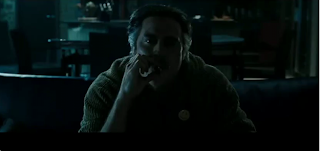
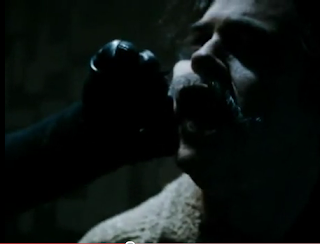
http://www.youtube.com/watch?v=GXLfTv42T8A&feature=related
The film is a Thriller/Action/Crime/Fantasy
Camera Techniques:
- The use of a MCU of one of the main characters right at the start at the movie establishes who we are positioned with.
- Then a slow track in on the TV screen of which he is watching shows that he is focused in on the TV.
- Use of a high angle on the man in his dressing gown which is followed by a CU to show his facial expresions, however he appears to not be fazed by the other mans appearance.
Editing:
- The use of expansion of time to slow down the fight between the two adding more suspense and action.
- The man in the dressing gown known as the 'Comedian' is driving the cuts from the very start as we get a MCU of him sitting on the sofa smoking a cigar then it cuts to what he is looking at also when he is fighting the other man he punches through a wall and it cuts to the other side to see his hand go through.
- The use of a soft focus to show the subjects shadow at the door helping us to see what he is looking at.
Mise - En - Scene:
- The whole opening sequence is set in the "Comedian's" appartment and seems to have a dull colourwash to help reinforce the time of day.
- The room is not lit very well and therefore creates a sense of mystery when we see the shadow upon the floor.
- The setting helps reinforce the genre of a thriller as it is a idealistic place to hold a fight where some one breaks in adding the mystery of why the man breaks in.
Sound:
- The music in the background is in such a contrast with the opening scene as it is relaxed and slow whereas the fight is quite quick and is over within a minute. This helps to notice what has happened him sitting alone watching TV then someone breaks in and kills him represents the irony of it all.
- Selective sound used on the punches and smashing to reinforce the sub genre of action also to help us identify what our main focus is with it competing with the music of the song.
- There is only a few lines of dialogue however this is effective as it doesnt give alot away about why this is going on instead leaving you on a cliff hanger as to why he was killed.
AT Film Openings: Thriller
Casino Royale (Martin Campbell, 2006)


- Establishing shot as shown in picture below of the building plus the use of subtitles to help position the audience
- Different use of shot angle on the man getting out of the car and when going up in the elevator
- The music used helps to create suspense
- Main character of the film spoke first thus identifying him
- Use of flash backs
- Lighting helped to create mystery as shown in picture below due to a shadow covering half of his face
CM Genre Research 1: Horror
Saw III: Darren Boulsman: 2006:


- The genre of "Saw III" is Horror.
- The camera technique used is of a Medium Close Up, with the composition of the shot focusing on the man's facial expression of pain. The camera is positioned at high angle in order to position the audience in the idea they are watching a game of someone being tortured.
- Also the iconography used of a tiled floor represents a prison, which can be seen as captivity. Furthermore the prop of the gun suggests death which is a crucial element of any horror and establishes that genre immediately.
SH Genre Research 1: Teen Drama
Adventureland (2009, Mottola) [0:00 - 2:34]
This film is an example of a teen drama, which also has elements of a comedy as a sub-genre.

This film is an example of a teen drama, which also has elements of a comedy as a sub-genre.
- There are many conventions of teen dramas which allow audiences to recognise the genre. These include stock characters, such as the popular character (the 'jock'), the 'rebel', the characters love interest and the socially awkward character or the 'nerd'. Stock locations are also used, which include high schools, locker rooms and house parties.
- The camera shot to introduce the main character is a MCU, which shows him staring at the girl, before speaking to her. The camera is also tracking in, to make the shot a CU. For teen dramas, there are many stock characters that are used and are easily recognisable by the audience. In this sequence, the main character can be seen as the socially awkward teen, as he only socialises with his two friends, and stares at the girl before speaking to her. This is a conventional character in teen films, as the audience immediately and maybe subconsciously recognises him.
- The shot-reverse-shot technique is used to show the beginning conversation, which reveals the two characters ending their relationship, which is a common subject in teen dramas.
- The alcoholic drinks (props) and the house party set is a typical setting for teen films.

- The music continues through the opening credits and the scene itself as the music at the party. The music is upbeat and is appropriate for the time period the film is set in.
CM Film Openings: Horror
Saw III: Darren Bousman: 2006:

- Having blackness surrounding the shot symbolises the unknown and towards humans that is recognised as fear.
- The facial expression of pain shows both fear and terror, reinforcing the horror genre.
- The use of a gun represents a cause of death, again supporting the horror theme.
- Tiled floor represents a prison which is can suggests imprisonment and captivity.
SH Film Openings: Teen Drama
Juno (2007, Reitman)
- This opening sequence establishes the main character, a teenager, and shows her walking through a cartoon street.
- This implies that she is still young, as she sees her life as a cartoon and is not ready to become pregnant, which is the situation the film focuses on.
Monday, 17 January 2011
Film Openings: Teen Drama
SH Adventureland (2009, Mottola):
- Opening credits are simplistic as it is a drama, however the film title 'Adventureland' has bright lettering which stand out.
- '1987' - setting of the film.
- The first shot is a CU of a teenager who is also the first character to speak. This establishes the teenager as the lead role.
- House party, alcohol, loud music - establishes the set as a typical teen setting
CM Film Openings: Horror
Sorority Row: 2009, Stewart Hendler:
- Immediatly begins with the idea of death, both faked and then a stabbing at the end of the opening sequence. This shows us that in order to establish the genre early in our film opening we will need to include a key feature such as death if we are doing a horror.
AT Film Openings: Thriller

Valkyrie(Bryan Singer, 2008):
- Establishs the events that will unfold in the film
- Represents which country their from through the opening credits (as shown in the picture the word 'Valkyrie' written in german.)
- The opening sequence identifys the main character
- Subtitles to tell us where we are positioning audience
- Realism of the representation of German Language through dialect in German
Subscribe to:
Posts (Atom)